Senior Dog Sundowners: Night Pacing Remedies in Dogs
Sundowner's syndrome, or canine cognitive dysfunction, causes nighttime pacing, disorientation, and anxiety in senior dogs due to disrupted sleep-wake cycles. Wisdom Paws recommends a consistent bedtime routine, nightlight use, and veterinary evaluation to rule out pain. Symptoms typically emerge in dogs over 9 years old.
Sundowners syndrome, a symptom of Canine Cognitive Dysfunction, causes senior dogs to pace, pant, and whine due to disrupted sleep-wake cycles, worsening after dusk. Wisdom Paws, led by Dr. Liz Fernandez, DVM, CVA, MA, offers Tele-Support Sessions nationwide and Quality of Life Consultations, helping families identify triggers and build calming nighttime routines for dogs with dementia.
Key Takeaways
- Sundowning represents the nighttime manifestation of Canine Cognitive Dysfunction, causing confusion and anxiety in senior dogs.
- Beta-amyloid plaque accumulation in the brain drives the progressive neurodegenerative condition affecting aging dogs.
- Common sundowner symptoms include pacing, panting, whining, and inability to settle once darkness falls.
- Practical nighttime management strategies help senior dogs and their families achieve better sleep quality together.
What Does Sundowning Look Like in Senior Dogs?
Evening restlessness in an aging dog often signals dog sundowners, the evening or overnight worsening of confusion, anxiety, pacing, panting, and general unease tied to canine cognitive dysfunction. Symptoms build as daylight fades and often peak well after the household settles in for the night. A dog who naps peacefully all afternoon can transform into a wandering, whining companion by dusk.
This pattern earns its nickname for a reason: sundowning is the night-time face of dog dementia. Daytime confusion and anxiety linked to cognitive decline intensify once evening arrives, then often carry through the overnight hours. The dog isn't being difficult. The disease itself is escalating on a predictable clock.
Is It Normal for a Dog's Confusion to Get Worse at Night?
Yes, and pet parents aren't imagining the pattern. A dog who seems steady and clear-headed during the day. Grows disoriented or unsettled at dusk is showing a recognized feature of cognitive decline, not a random bad night. Owners who suspect something is off after dark are usually right.
Common signs to watch for include:
- Night pacing back and forth through the house without settling
- Panting or restlessness that has no obvious physical cause
- Whining, barking, or vocalizing that increases after sunset
- Staring at walls or corners, appearing lost in familiar rooms
Sundowning drains everyone involved. The dog struggles through hours of confusion and unease. The humans nearby lose sleep trying to soothe a companion who can't quite settle. Recognizing the pattern early makes it easier to respond with patience instead of frustration. To start exploring calming remedies before exhaustion sets in for the whole household.
Why Does Cognitive Decline Worsen After Dark?
Evening hours hit a declining canine brain harder than daytime does, and the reason lies in biology, not bad behavior. Veterinarians frequently describe dog dementia as the canine equivalent of Alzheimer's disease, a comparison that helps explain why symptoms follow such a familiar pattern. The clinical name is Canine Cognitive Dysfunction (CCD), a progressive neurodegenerative condition affecting aging dogs.
CCD develops as beta-amyloid plaques build up in the brain over time. These plaques disrupt memory, interfere with learning, and throw off normal sleep-wake cycles. That last piece matters most for the nighttime crisis. Many families face: a dog whose internal clock no longer distinguishes day from night struggles most exactly when the house goes quiet.
Why does confusion get worse specifically at night?
Fading light, mounting fatigue, and a drop in mental stimulation combine to intensify confusion as evening sets in, mirroring the same sundowning pattern seen in human dementia patients. A dog who seemed calm all afternoon may exhibit pacing, panting, or whining at night due to the effects of cognitive dysfunction. Reduced visual cues make an already-confused brain work harder to recognize familiar rooms and furniture, which fuels anxiety rather than settling it.
What actually happens in the brain during sundowning?
Sundowning is not a behavior choice. It is a neurological response to accumulating plaque damage colliding with the natural drop in stimulation that comes at dusk. Consider the chain reaction:
- Beta-amyloid buildup impairs memory and learning over months or years.
- Sleep-wake regulation breaks down, blurring the line between day and night.
- Evening fatigue and dimming light compound the existing confusion.
- Anxiety, pacing, and vocalizing follow as the dog struggles to orient.
Recognizing this pattern gives pet parents something powerful: an explanation, not blame. Dog sundowners night pacing remedies work best when they address this underlying neurological shift rather than treating restlessness as a simple training issue.
What Are the Telltale Signs of Sundowners?
A senior dog snoozing through most of the day, then pacing, panting, whining, or trembling once the house goes dark, is showing one of the clearest patterns of dog sundowners. Waking repeatedly through the night, unable to settle, rounds out the picture for many families. This day-to-night flip is exactly what makes sundowning so hard on everyone in the house. The dog is exhausted. The humans trying to comfort him are exhausted too, and that shared fatigue tends to build night after night.
Fading daylight itself seems to play a role. Fatigue, less mental stimulation during the day, and the simple change in light levels as evening falls all feed into rising confusion and anxiety once the sun goes down. That's part of why symptoms often look mild or even absent in the morning, then intensify by dinnertime.
What does dog sundowning actually look like at night?
Picture a dog who naps peacefully all afternoon, then starts night pacing in tight circles through the living room after dark. Shaking or trembling sometimes joins the restlessness, along with whining that seems to come from nowhere. Sleep gets interrupted again and again, for the dog and for anyone sharing the house.
Is occasional nighttime restlessness the same as sundowners?
Not necessarily. One rough night doesn't confirm a pattern. Sundowners describes a repeating cycle, night after night, where confusion and distress reliably worsen as daylight fades. Watching for that consistency helps separate a passing bad evening from true sundowning.
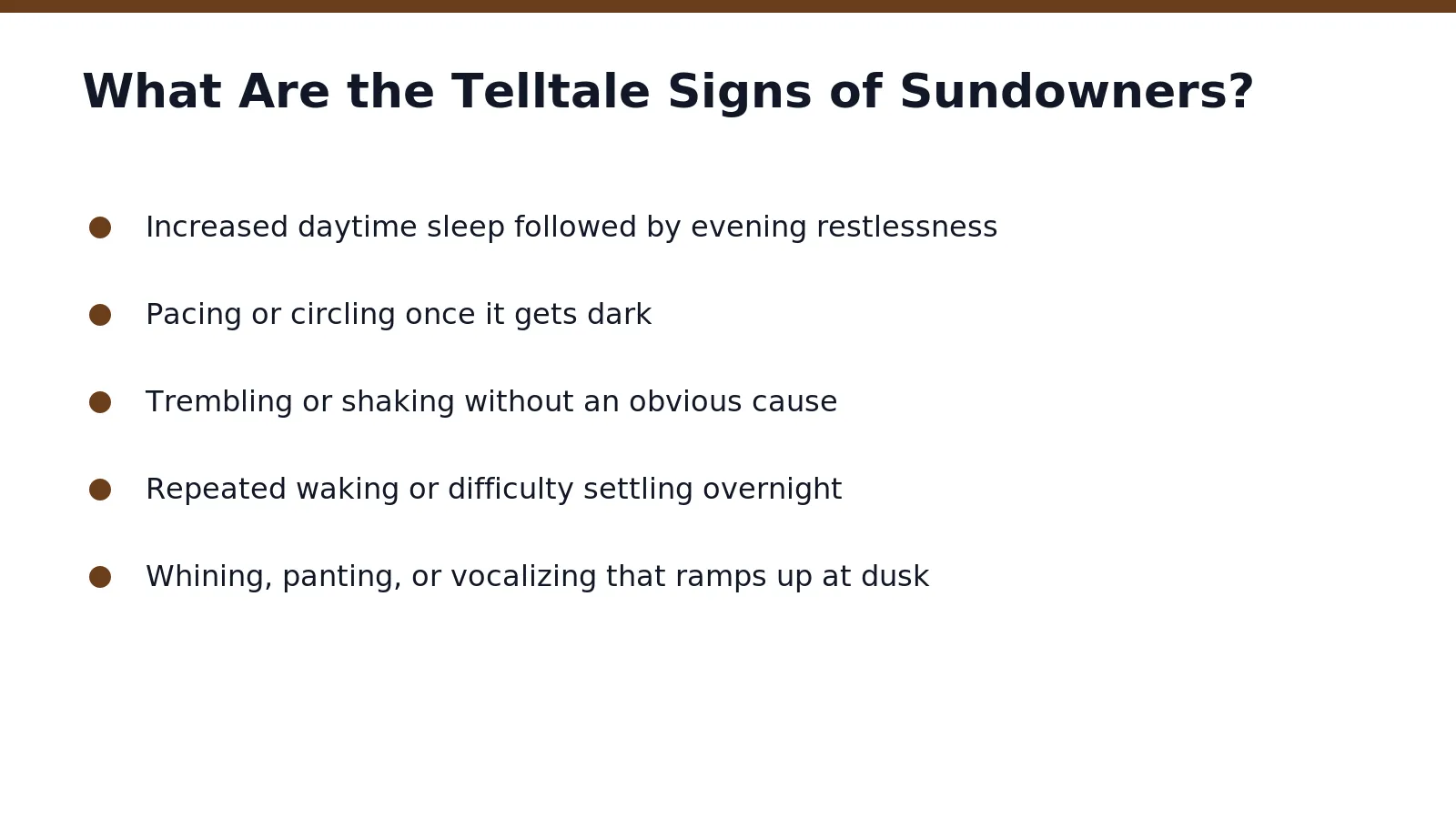
Common signs worth tracking include:
- Increased daytime sleep followed by evening restlessness
- Pacing or circling once it gets dark
- Trembling or shaking without an obvious cause
- Repeated waking or difficulty settling overnight
- Whining, panting, or vocalizing that ramps up at dusk
Could Another Health Problem Cause the Pacing?
Yes, several medical conditions mimic the restlessness and confusion seen with canine cognitive decline. Pain, urinary trouble, heart or breathing disease, Cushing's disease, and anxiety can all produce the same evening unraveling that pet parents mistake for dog sundowners. A sudden worsening of night-time symptoms deserves a closer look rather than an assumption that dementia explains everything.
Cognitive changes in aging dogs prove trickier to identify than most other senior health issues. Many conditions surface clearly through a physical exam, routine bloodwork, or diagnostic imaging. A urinary infection shows up in a urine sample. Heart disease often reveals itself through a stethoscope or chest X-ray. Cognitive dysfunction doesn't work that way, since there's no blood panel or scan that confirms it.
Is there a test that diagnoses dog dementia?
No single test exists for canine dementia the way cognitive exams exist for people. Veterinarians can't ask a dog to draw a clock or recall a list of words. Diagnosis relies on ruling out other causes first, then matching the remaining pattern of symptoms to what's known about cognitive dysfunction.
Can brain diseases other than dementia cause nighttime pacing?
Yes. Tumors and meningitis both disrupt the sleep-wake cycle in ways that look remarkably similar to sundowning. Seizures at night pose a particular challenge too, since a dog may already look confused and disoriented by the time an owner wakes up to check on them, making the pacing appear to be simple restlessness rather than a neurological event.
Given how many conditions overlap in symptoms, a veterinary visit belongs at the top of the list before starting any night pacing remedies at home. Ruling out pain, organ disease, and neurological causes gives families a clearer path toward the right kind of support, whether that means medical treatment or a plan built around managing cognitive decline itself.
A quick look at how other conditions can produce the same evening restlessness, and what sets each one apart:
| Condition | Common Signs | How It's Identified | Why It Mimics Sundowners |
|---|---|---|---|
| Pain (arthritis, injury) | Restlessness, reluctance to lie down or settle | Physical exam, orthopedic assessment | Discomfort triggers pacing and whining at night |
| Urinary trouble | Frequent urination, accidents, straining | Urine sample | Repeated need to go out looks like aimless pacing |
| Heart or breathing disease | Labored breathing, coughing, restlessness when lying flat | Stethoscope exam, chest X-ray | Trouble breathing worsens once a dog lies down for the night |
| Cushing's disease | Increased thirst, panting, hair loss | Bloodwork | Excess panting resembles sundowner anxiety |
| Anxiety (non-cognitive) | Vocalizing, pacing, distress when alone | Behavioral history after ruling out medical causes | Looks identical to cognitive-driven restlessness without brain changes |
What Actually Calms Nighttime Pacing and Anxiety?
A blend of approaches works best: environmental changes, a steady evening routine, and veterinarian-guided treatment, layered together rather than tried one at a time. No single fix resolves dog sundowners night pacing remedies on its own. Dogs experiencing evening confusion, vocalizing, or restless wandering as daylight fades need a plan that addresses the whole picture, not just the symptom in front of an owner at 9 p.m.
Why does sundowning happen in the first place?
Aging dog brains can develop cognitive dysfunction, a condition that mirrors dementia in people. Researchers understand human dementia far better than the canine version, which means treatment often relies on managing symptoms rather than reversing the underlying decline. That gap is exactly why environmental support matters so much for dogs living with this condition.
What environmental changes actually help?
Predictability calms an anxious, confused brain. Dogs pacing at night often respond to consistent cues that signal safety. Routine, even when their sense of time and place has grown unreliable.
Consider a few adjustments that support a senior dog through the evening hours:
- Keep a fixed bedtime routine: same feeding time, same walk, same wind-down sequence night after night
- Reduce evening stimulation: dim harsh lighting and limit loud television or household noise after dinner
- Use nightlights in hallways and bedrooms so a disoriented dog can navigate without panic
- Block access to stairs or unsafe areas where confused pacing could lead to a fall
- Keep the sleeping area unchanged; furniture rearranging or new bedding can worsen confusion
Veterinary guidance rounds out the picture. A veterinarian can evaluate whether a dog's nighttime unraveling stems purely from cognitive decline or from a separate, treatable issue like pain or sleep disruption. Because canine cognitive dysfunction remains less studied than its human counterpart, professional input helps families avoid guessing at solutions that don't fit their dog's specific pattern. Combining routine, environment, and veterinary support gives families their best shot at quieter, calmer nights.
How Can a Steady Routine Ease the Evening?
Predictability calms an aging brain that struggles to make sense of change. A steady evening rhythm gives a dog fewer surprises to process just as confusion tends to peak. Veterinarian Dr. Julie Buzby, writing for a veterinary guide on sundowners, notes that this condition is a common problem for gray-muzzled dogs facing the challenges that come with advancing age. Those challenges can include a range of medical issues, some caught through a physical exam or routine bloodwork, others harder to pin down without specialized imaging.
Consistency does more than soothe; it also prevents caregivers from falling into habits that quietly make things worse. Sources on canine cognitive dysfunction point out that many caregivers unintentionally normalize or worsen symptoms without realizing it. Accepting nighttime pacing as ordinary aging is one common misstep. Frustration over house-soiling accidents is another. The dog has often simply forgotten the routine rather than chosen to break it.
What does a helpful evening routine actually include?
A workable routine keeps the same order of events every night: a wind-down walk, a quiet feeding time, dim lighting, and a consistent bedtime. Small, repeated cues teach the dog's brain what comes next, even when memory falters.
Can a dog with dementia still enjoy life?
Yes. Even with cognitive decline, senior dogs remain wonderful companions for their families, and a calmer evening often means a calmer relationship overall. Families who commit to structure typically notice fewer flare-ups of restlessness and pacing.
The goal is not to fight the confusion. To work around it, using dog sundowners night pacing remedies built on routine rather than punishment. A guided support session helps families design that rhythm around their own dog's needs.
When Should You Loop In Your Veterinarian?
A veterinary visit becomes essential the moment nighttime confusion looks different from ordinary restlessness, especially when a dog's body seems to be doing something involuntary. Interrupted sleep in senior dogs stems from many different underlying causes, not just cognitive decline, and sorting out which one is at play requires professional eyes, not guesswork.
Could it be something more than confusion?
Nighttime seizures sometimes get mistaken for simple confused pacing. By the time an owner wakes up. Reaches the dog, the seizure itself may be over, leaving only the post-seizure grogginess and disorientation to witness. That pattern can look a lot like ordinary dog sundowners night pacing remedies territory. It isn't, and a vet visit helps rule out neurological causes that need very different treatment.
A few signs deserve a same-week call rather than a wait-and-see approach:
- Sudden collapse, stiffening, or paddling limbs before or after the pacing episode
- Disorientation that doesn't improve once the lights come on and the dog is fully awake
- New nighttime accidents paired with pacing, which can point to pain or organ changes
- Pacing that appears overnight with no gradual buildup over weeks or months
Why does professional guidance matter so much here?
Sundowning often becomes the hardest stretch of the entire disease, robbing both the dog and the owner of sleep night after night. Support exists for the human half of that equation too, and no family has to sort through the confusion alone.
Wisdom Paws is located in California, USA. Wisdom Paws guides pet parents through exactly this kind of nighttime decline, whether the question is medical urgency or simply how much longer a beloved dog has left in a comfortable, dignified stretch of life.
How Do You Find Support Through This Journey?
Guidance for dog sundowners exhaustion comes through a real relationship, not a one-time checklist. Dr. Liz Fernandez, a veterinarian, author, and pet end-of-life specialist, walks families through cognitive decline and the sleepless nights that come with it. Her background blends veterinary medicine, hospice and palliative care training, and human-animal grief counseling. That combination matters, because a senior dog's night pacing rarely presents as just a medical puzzle. It's also an emotional one, tangled up with fear, fatigue, and love.
Families often carry quiet worry for weeks before reaching out. Sitting with them as they share those fears. Their grief over a dog who once slept soundly through the night, is treated as a sacred trust. Compassionate, judgment-free perspective helps families reach decisions with clarity instead of panic.
Who Actually Needs Support Here, the Dog or the Owner?
Both do, honestly. Sundowning steals sleep from everyone in the house, the dog and the humans caring for that dog. Exhausted owners deserve as much attention as the confused, pacing pet at 2 a.m.
What Does Ongoing Guidance Look Like?
Support isn't a single conversation. It typically includes:
- Reviewing the dog's evening patterns and specific remedies already tried
- Discussing realistic expectations for cognitive decline over time
- Offering emotional support for caregivers running on fragmented sleep
- Helping families recognize when quality of life conversations need to start
No two households experience sundowning the same way. Some dogs pace for twenty minutes and settle; others wander until dawn. What stays constant is the value of having someone steady beside a family, someone who understands both the veterinary reality and the grief underneath it, ready to help them find their footing again.
FAQ
What is sundowning in senior dogs?
Sundowning is the nighttime manifestation of Canine Cognitive Dysfunction, causing pacing, panting, whining, and confusion that intensify after dusk. Beta-amyloid plaques disrupt the brain's sleep-wake cycles, making symptoms peak once the household settles in for the night.
Why does a dog's confusion get worse after dark?
Beta-amyloid plaques build up in the aging brain, disrupting memory, learning, and normal sleep-wake cycles. A dog's internal clock stops distinguishing day from night, so confusion peaks exactly when the house grows quiet.
How does Wisdom Paws support dogs with sundowners?
Wisdom Paws, led by Dr. Liz Fernandez, DVM, CVA, MA, offers nationwide Tele-Support Sessions and Quality of Life Consultations from California. These services help families identify triggers and build calming nighttime routines for dogs with dementia.
Conclusion
In closing, sundowners in senior dogs reflects the natural aging process, and recognizing these signs gives you the power to respond with compassion and practical support. Whether you adjust the environment, explore calming techniques, or work with your veterinarian on a care plan, you're honoring your dog's comfort during this tender chapter. Your attentiveness to these nighttime changes strengthens the bond you share, and that presence matters deeply as your faithful companion navigates their golden years.